
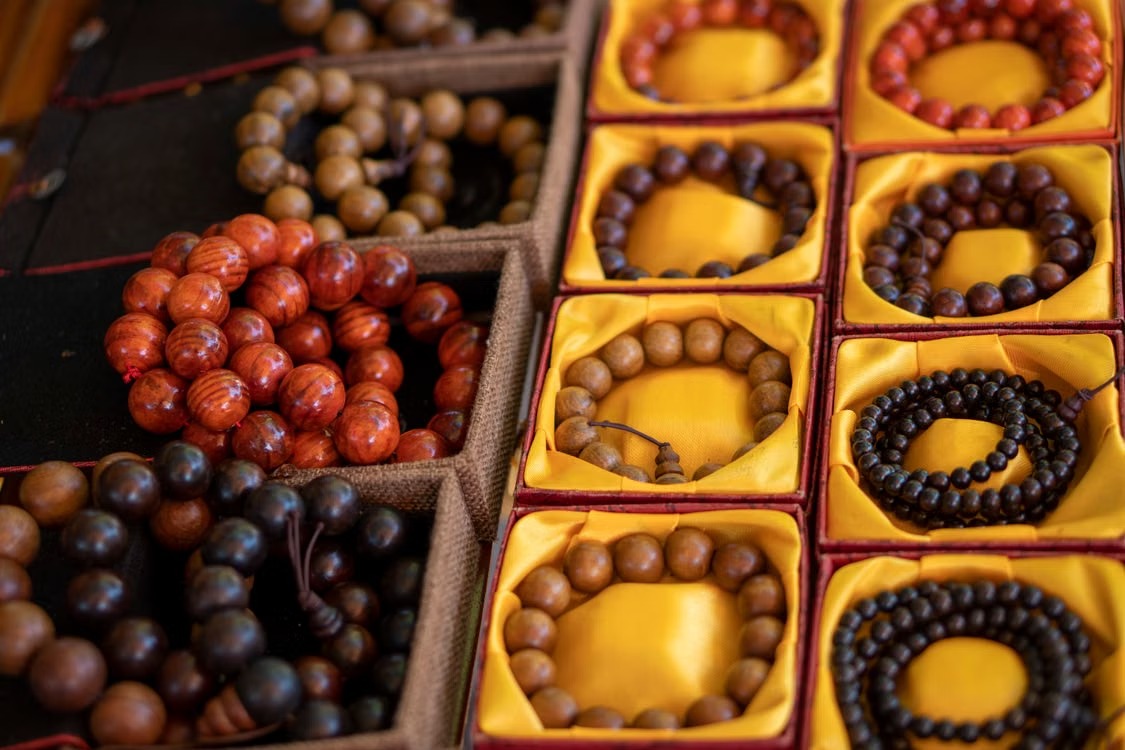
You’ve probably seen Rudraksha beads around a sadhu’s neck or on someone’s wrist. But did you know that the types of Rudraksha differ according to their natural faces, or mukhis?
Each mukhi carries a different traditional association with a deity, planet, and purpose. Therefore, choosing a Rudraksha should involve more than simply selecting the rarest or most expensive bead.
From the rare 1 Mukhi to the widely worn 5 Mukhi and the sought-after 21 Mukhi, this guide explains the types of Rudraksha, their traditional benefits, associated deities, and who may consider wearing them.
Quick Answer: Types of Rudraksha at a Glance
The types of Rudraksha are primarily classified by their natural mukhis, or faces. Common varieties range from 1 Mukhi to 21 Mukhi. Extremely rare beads may have higher counts, while special natural formations include Gauri Shankar, Gauri Ganesh, Ganesh Rudraksha, and Trijuti.
Each type has its own traditional deity, planetary association, and purpose.
Most importantly, a higher mukhi does not automatically mean a better Rudraksha. Instead, suitability depends on your intention, spiritual practice, and, where relevant, your birth chart.
Key Takeaways
- Rudraksha types are identified by their natural mukhis, or faces.
- Each mukhi has a traditional deity and planetary association.
- The 5 Mukhi remains the most commonly worn variety.
- Higher mukhis are not automatically more powerful.
- Special forms such as Gauri Shankar and Ganesh Rudraksha have distinct symbolism.
- Authenticity matters more than rarity or price.
- For specific astrological purposes, personalised guidance can help you choose appropriately.
Why Understanding the Types of Rudraksha Matters
The Rudraksha market can feel overwhelming. Sellers often promote rare beads as automatically more powerful. However, that approach can encourage unnecessary spending.
Instead, understanding the types of Rudraksha can help you make a more informed choice.
Perhaps you want greater calm. Maybe your focus is wealth, courage, protection, learning, relationships, or spiritual development. Each goal may point toward a different traditional association.
Therefore, learn the purpose of a bead before purchasing it.
What Is Rudraksha and Why Does the Mukhi Matter?
Rudraksha comes from the seed of the Elaeocarpus ganitrus tree. The dried seed traditionally serves as a prayer bead in Hindu spiritual practice. Botanical and pharmacognostic sources also identify Elaeocarpus ganitrus as the plant associated with Rudraksha beads.
The natural vertical lines on a bead are called mukhis, or faces. Traditionally, practitioners use the number of faces to distinguish different Rudraksha varieties.
In spiritual traditions, each mukhi carries particular associations with deities, planets, qualities, and life themes.
For that reason, the mukhi count forms the foundation for understanding the types of Rudraksha.
Types of Rudraksha: 1 to 7 Mukhi
The first seven varieties remain among the most familiar and widely discussed Rudraksha beads.
1 Mukhi Rudraksha
Traditional deity: Lord Shiva
Planetary association: Sun
Traditional themes: Awareness, detachment, spiritual consciousness, and liberation
The 1 Mukhi is traditionally regarded as one of the rarest Rudraksha varieties. Genuine examples can be difficult to authenticate.
Because of its rarity and strong spiritual symbolism, buyers should verify authenticity carefully before purchasing one.
2 Mukhi Rudraksha
Traditional deity: Ardhanareshwar
Planetary association: Moon
Traditional themes: Relationships, harmony, emotional balance, and unity
The 2 Mukhi traditionally represents the union of masculine and feminine energies. Therefore, practitioners often associate it with relationship harmony.
3 Mukhi Rudraksha
Traditional deity: Agni
Planetary association: Mars
Traditional themes: Confidence, transformation, and releasing past guilt
The 3 Mukhi is traditionally connected with inner transformation. It may appeal to those seeking greater confidence and emotional release.
4 Mukhi Rudraksha
Traditional deity: Brahma
Planetary association: Mercury
Traditional themes: Learning, memory, communication, and expression
Students, writers, and people involved in communication may find the traditional symbolism of the 4 Mukhi especially meaningful.
5 Mukhi Rudraksha
Traditional deity: Kalagni Rudra
Planetary association: Jupiter
Traditional themes: Calmness, spiritual practice, focus, and general wellbeing
The 5 Mukhi is the most commonly worn Rudraksha. Traditionally, practitioners consider it suitable for a broad range of people.
If you’re new to Rudraksha, this variety often provides a simple starting point.
6 Mukhi Rudraksha
Traditional deity: Kartikeya
Planetary association: Venus
Traditional themes: Willpower, discipline, confidence, and emotional grounding
The 6 Mukhi may suit those who want to develop greater discipline and steadiness in their daily routine.
7 Mukhi Rudraksha
Traditional deity: Mahalakshmi
Planetary association: Saturn
Traditional themes: Wealth, abundance, and relief from Saturn-related challenges
Tradition connects the 7 Mukhi with prosperity and material stability. Consequently, people focused on financial growth often explore this bead.
Types of Rudraksha: 8 to 14 Mukhi
The next group carries a range of traditional associations, from obstacle removal to courage and intuition.
8 Mukhi Rudraksha
Traditional deity: Ganesha
Planetary association: Rahu
Traditional themes: Obstacle removal, clarity, and new beginnings
People often associate the 8 Mukhi with Lord Ganesha’s ability to clear obstacles.
9 Mukhi Rudraksha
Traditional deity: Durga
Planetary association: Ketu
Traditional themes: Courage, energy, protection, and fearlessness
The 9 Mukhi carries strong associations with Goddess Durga. Therefore, devotees often connect it with strength and protection.
10 Mukhi Rudraksha
Traditional deity: Vishnu
Traditional themes: Protection, balance, and reducing negative influences
The 10 Mukhi traditionally represents protective energy. Practitioners may consider it when seeking greater stability and spiritual protection.
11 Mukhi Rudraksha
Traditional deity: Hanuman and the Eleven Rudras
Traditional themes: Courage, wisdom, confidence, and steadiness
The 11 Mukhi carries strong associations with courage and spiritual strength.
12 Mukhi Rudraksha
Traditional deity: Surya
Planetary association: Sun
Traditional themes: Leadership, vitality, confidence, and radiance
The 12 Mukhi traditionally connects with the Sun’s qualities of leadership and personal strength.
13 Mukhi Rudraksha
Traditional deity: Kamadeva / Indra
Planetary association: Venus
Traditional themes: Charisma, attraction, fulfilment, and confidence
The 13 Mukhi is traditionally associated with attraction and personal magnetism.
14 Mukhi Rudraksha
Traditional association: Hanuman / Deva Mani
Planetary association: Saturn
Traditional themes: Intuition, insight, and decision-making
The 14 Mukhi has a reputation for supporting intuition. As a result, practitioners often connect it with clearer judgement and awareness.
Types of Rudraksha: 15 to 21 Mukhi
Higher-mukhi Rudraksha varieties are much less common. Their rarity, however, does not automatically make them suitable for everyone.
15 Mukhi Rudraksha
Traditional deity: Pashupati / Shiva
Traditional themes: Devotion, emotional awareness, and heart-centred consciousness
The 15 Mukhi traditionally carries a strong Shiva connection.
16 Mukhi Rudraksha
Traditional deity: Mahamrityunjaya / Shiva
Traditional themes: Protection, courage, healing symbolism, and overcoming fear
The 16 Mukhi is traditionally valued for protective spiritual symbolism.
17 Mukhi Rudraksha
Traditional association: Vishwakarma / Katyayani
Traditional themes: Property, fulfilment, material growth, and sudden gains
Tradition connects this bead with creation, achievement, and material aspirations.
18 Mukhi Rudraksha
Traditional deity: Bhumi Devi
Traditional themes: Stability, property, grounding, and connection with the Earth
The 18 Mukhi symbolically represents Earth energy and stability.
19 Mukhi Rudraksha
Traditional deity: Narayana / Vishnu
Traditional themes: Comfort, fulfilment, abundance, and worldly prosperity
The 19 Mukhi is traditionally connected with material wellbeing and fulfilment.
20 Mukhi Rudraksha
Traditional deity: Brahma
Traditional themes: Knowledge, creativity, awareness, and spiritual insight
The 20 Mukhi is rare and carries strong associations with knowledge and higher understanding.
21 Mukhi Rudraksha
Traditional deity: Kubera
Traditional themes: Wealth, abundance, prosperity, and material success
The 21 Mukhi remains one of the most sought-after higher-mukhi varieties. Its traditional connection with Kubera gives it a strong association with prosperity.
Rare and Special Rudraksha Forms
Not every Rudraksha fits neatly into the 1-to-21 Mukhi classification.
Several naturally occurring forms hold special significance.
Gauri Shankar Rudraksha
Gauri Shankar consists of two Rudraksha beads naturally joined together. Tradition associates the formation with Lord Shiva and Goddess Parvati.
Therefore, devotees often connect it with love, marriage, unity, and family harmony.
Gauri Ganesh Rudraksha
Gauri Ganesh features a natural protrusion that resembles a smaller bead attached to the main bead. Traditional symbolism connects it with Ganesha and Parvati.
Ganesh Rudraksha
Ganesh Rudraksha contains a natural trunk-like protrusion. Devotees associate it with Lord Ganesha and traditionally use it for obstacle removal and new beginnings.
Trijuti Rudraksha
Trijuti consists of three naturally joined Rudraksha beads. Its association with Brahma, Vishnu, and Mahesh makes it an exceptionally significant natural formation in Rudraksha traditions.
Beads with 22 to 27 mukhis also receive attention. However, they remain extremely rare. For most people, authenticity and suitability matter much more than rarity.
How to Choose Between Different Types of Rudraksha
Start with your intention.
Are you looking for:
- Calm and emotional balance?
- Wealth and abundance?
- Courage and confidence?
- Protection?
- Learning and concentration?
- Relationship harmony?
- Spiritual development?
Once you identify your goal, you can explore the relevant traditional associations.
If your purpose involves an astrological remedy, consider your birth chart as well. A practitioner can help you determine whether a specific mukhi aligns with your planetary requirements.
Comparison Table: Types of Rudraksha
| Mukhi | Traditional Deity | Planet | Traditional Association |
|---|---|---|---|
| 1 Mukhi | Shiva | Sun | Awareness, detachment |
| 2 Mukhi | Ardhanareshwar | Moon | Relationships, harmony |
| 3 Mukhi | Agni | Mars | Confidence, transformation |
| 4 Mukhi | Brahma | Mercury | Learning, memory, speech |
| 5 Mukhi | Kalagni Rudra | Jupiter | Calm, focus, wellbeing |
| 6 Mukhi | Kartikeya | Venus | Willpower, grounding |
| 7 Mukhi | Mahalakshmi | Saturn | Wealth, abundance |
| 8 Mukhi | Ganesha | Rahu | Obstacle removal |
| 9 Mukhi | Durga | Ketu | Energy, courage, protection |
| 10 Mukhi | Vishnu | — | Protection, balance |
| 11 Mukhi | Hanuman / Eleven Rudras | — | Courage, wisdom |
| 12 Mukhi | Surya | Sun | Leadership, vitality |
| 13 Mukhi | Kamadeva / Indra | Venus | Charisma, fulfilment |
| 14 Mukhi | Hanuman / Deva Mani | Saturn | Intuition, decision-making |
| 15 Mukhi | Pashupati / Shiva | — | Devotion, awareness |
| 16 Mukhi | Mahamrityunjaya / Shiva | — | Protection, courage |
| 17 Mukhi | Vishwakarma / Katyayani | — | Property, fulfilment |
| 18 Mukhi | Bhumi Devi | Earth | Stability, grounding |
| 19 Mukhi | Narayana / Vishnu | — | Comfort, fulfilment |
| 20 Mukhi | Brahma | — | Knowledge, insight |
| 21 Mukhi | Kubera | — | Wealth, abundance |
What Most Websites Get Wrong About Rudraksha
Many online guides present higher-mukhi beads as automatically superior. That claim can create unnecessary confusion.
A rare bead does not automatically become the right bead for you.
Instead, consider three things:
Authenticity. Is the bead genuine?
Suitability. Does its traditional purpose match your intention?
Guidance. If you want an astrological remedy, does it align with your chart?
Consequently, a genuine 5 Mukhi may offer a more suitable starting point than an expensive high-mukhi bead chosen simply because it looks rare.
Common Mistakes When Choosing Rudraksha
Avoid these common mistakes:
- Assuming a higher mukhi always means greater power.
- Spending heavily on rare beads without understanding their purpose.
- Buying from an unverified seller.
- Trusting dramatic promises of guaranteed results.
- Choosing a bead only because it is trending online.
- Ignoring your actual intention.
- Treating traditional spiritual claims as guaranteed medical or financial outcomes.
Research into Elaeocarpus ganitrus has examined its botanical and pharmacological properties. However, researchers also note that more work remains necessary to understand its effects fully.
Therefore, Rudraksha should complement responsible personal, financial, and healthcare decisions rather than replace them.
Myth vs Reality: Types of Rudraksha
Myth: A higher mukhi automatically provides greater benefits.
Reality: Each mukhi has different traditional associations. The right choice depends on your purpose and, where relevant, your chart.
Myth: The most expensive Rudraksha must be the most effective.
Reality: Price and rarity do not guarantee suitability.
Myth: Every Rudraksha claim has scientific proof.
Reality: Traditional beliefs and scientific evidence represent different forms of knowledge. Treat health-related claims carefully and consult a qualified professional when necessary.
Practitioner Insight
At Astro Sanjivani, we often meet people who believe they need an extremely rare Rudraksha because a seller recommended it.
However, their actual goals may point elsewhere.
In many cases, a simpler and more suitable bead can meet their traditional spiritual objective. That approach also helps people avoid unnecessary spending.
Our philosophy is straightforward: choose suitability over hype and authenticity over rarity.
A Real-Life Example
Consider a fictional client named Rakesh, a 37-year-old businessman.
He wanted to purchase an expensive 14 Mukhi Rudraksha after a seller promised that it would solve all his problems. His actual goals, however, centred on better focus and financial stability.
After discussing his goals and chart, a practitioner suggested exploring a traditional combination involving 5 Mukhi and 7 Mukhi Rudraksha instead.
Over the following months, Rakesh reported feeling calmer and more grounded in his decisions. The beads supported his spiritual routine, but they did not replace his own efforts.
This example illustrates an important principle: the most expensive bead is not necessarily the most suitable bead.
How to Know Which Rudraksha May Suit You
If the different types of Rudraksha feel overwhelming, start with your objective.
For general spiritual practice, many people begin with 5 Mukhi. For a specific intention, explore the traditional associations of the relevant mukhi.
If your purpose involves an astrological remedy, consider a personalised chart assessment before choosing a higher-mukhi bead.
You can also read our guide on [Panchmukhi Rudraksha] to learn more about the commonly worn 5 Mukhi.
For gemstone-based planetary remedies, you may also find our [Gemstone Guide] useful before deciding between a Rudraksha and a gemstone.
From the Astrologer’s Desk
We value Rudraksha because the tradition offers many options for different spiritual intentions.
Nevertheless, choosing wisely matters more than choosing something rare.
Start with your goal. Check authenticity. Understand the traditional symbolism. Then, if astrology forms part of your decision, consider your birth chart.
That approach creates a more thoughtful spiritual practice.
Frequently Asked Questions About Types of Rudraksha
How many types of Rudraksha are there?
Rudraksha varieties commonly range from 1 to 21 Mukhi. Extremely rare beads may have higher mukhi counts, while special natural formations include Gauri Shankar, Gauri Ganesh, Ganesh Rudraksha, and Trijuti.
Which Rudraksha is best for everyone?
The 5 Mukhi, also called Panchmukhi, is the most commonly worn variety. Traditional practice generally considers it suitable for a broad range of people.
However, individual spiritual or astrological needs can differ. Therefore, personalised guidance may help when you want a specific remedy.
Is a higher-mukhi Rudraksha more powerful?
Not necessarily.
Each mukhi carries different traditional associations. A higher number does not automatically make a bead more suitable or beneficial.
What is Gauri Shankar Rudraksha?
Gauri Shankar consists of two Rudraksha beads naturally joined together. Tradition associates it with Shiva and Parvati and connects it with unity, relationships, and family harmony.
How can I identify a genuine Rudraksha?
Look for natural, continuous mukhi lines and a naturally textured surface. However, simple home tests cannot conclusively establish authenticity.
For valuable or rare beads, professional laboratory verification provides stronger evidence.
Trust and Disclaimer
Astrology and spiritual traditions can offer guidance and personal meaning, but they do not guarantee specific outcomes.
Individual experiences can vary. Therefore, use Rudraksha as part of a thoughtful spiritual practice rather than as a guaranteed solution for health, financial, relationship, or career problems.
For medical concerns, consult a qualified healthcare professional. Likewise, make financial decisions using appropriate professional advice.
Expert Summary
The types of Rudraksha range from 1 Mukhi to 21 Mukhi, along with rare natural formations such as Gauri Shankar, Ganesh, Gauri Ganesh, and Trijuti.
Each variety carries its own traditional deity, planetary association, and purpose.
The 5 Mukhi remains a popular starting point because of its broad traditional appeal. Meanwhile, higher mukhis may serve more specific spiritual or astrological intentions.
Ultimately, the wisest choice is not always the rarest one.
Choose authenticity over hype. Choose suitability over scarcity. Most importantly, choose a bead that supports your intention and spiritual practice.
Conclusion
From the rare 1 Mukhi to the sought-after 21 Mukhi, the types of Rudraksha offer a fascinating range of traditional symbolism.
Some varieties focus on spiritual awareness. Others connect with courage, prosperity, relationships, protection, or knowledge. Special forms such as Gauri Shankar and Trijuti add another layer of meaning to this ancient practice.
However, you do not need the rarest bead to begin.
A genuine Rudraksha that suits your purpose can provide a meaningful foundation for prayer, meditation, and spiritual reflection.
If you’re unsure which Rudraksha aligns with your goals or birth chart, consider a personalised consultation before making your choice.