
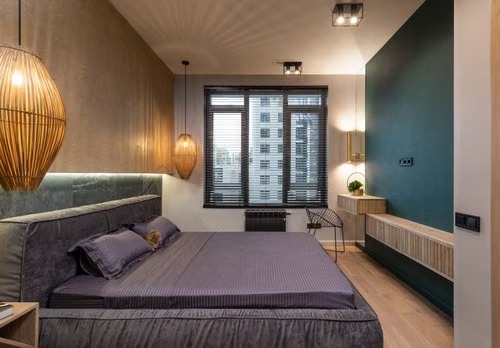
You spend roughly a third of your life in your bedroom, so it’s worth getting the basics right. Bedroom Vastu focuses on a few key areas: which direction your bed faces, which colours support restful sleep, and which common layout mistakes quietly disrupt your rest. This guide walks through each of these, along with specific things to avoid, so you can apply these principles whether you’re setting up a new room or adjusting an existing one. For a broader look at how direction shapes a home’s energy overall, see this overview of Vastu Shastra.
The Best Direction for Your Bedroom
Vastu recommends the southwest corner of the home for the master bedroom, since this direction relates to stability, strength, and grounded energy. The south and west zones work as reasonable alternatives if the southwest isn’t available in your layout.
Avoid placing the bedroom in the northeast corner specifically, since Vastu tradition reserves this zone for spiritual and meditative energy, which doesn’t pair well with rest. Children’s bedrooms follow slightly different guidance, often working well in the west or north zones instead.
Bed Placement: The Core of Bedroom Vastu
Once you’ve settled on the room, bed placement matters just as much as the room’s overall direction.
Sleep with your head pointing south or east. This orientation is traditionally believed to support deep, restful sleep and better overall health. Avoid sleeping with your head pointing north, since Vastu tradition considers this direction disruptive to sleep quality, partly linked to the body’s magnetic alignment.
Position the bed against a solid wall. Place your bed so its headboard rests against a solid wall, ideally without a window directly behind it. This gives you a sense of support and stability while you sleep.
Leave space on both sides of the bed. Avoid pushing the bed into a corner with one side flush against a wall. Equal access on both sides supports better energy flow around the bed, according to Vastu principles.
Avoid placing the bed directly under a beam. If your bedroom has an exposed ceiling beam, position the bed so it doesn’t sit directly beneath it. Vastu tradition considers this placement a source of subtle pressure during sleep.
Colours That Support Restful Sleep
Colour choice plays a real role in how a bedroom feels and functions. Soft, calming shades — light blues, gentle greens, warm creams, and soft pinks — work particularly well for bedroom walls, since they support relaxation without overstimulating the space.
Avoid bold, intense colours like bright red or black across large wall surfaces, since Vastu tradition considers these too energising for a room meant to support rest. If you love a bolder shade, use it sparingly as an accent through cushions, artwork, or a single feature wall, rather than across the entire room.
What to Avoid in Bedroom Layout and Decor
A few specific choices are worth avoiding, according to Vastu guidance for bedrooms.
Mirrors facing the bed. Vastu tradition strongly advises against a mirror positioned to reflect the bed directly, since this is believed to create restless energy during sleep. If you need a mirror in the room, position it on a wall that doesn’t face the bed, or add a cover you can close at night.
A television in direct view of the bed. Beyond the practical sleep-hygiene reasons to avoid screens near bedtime, Vastu tradition also considers a TV facing the bed disruptive to restful, undisturbed sleep.
Cluttered spaces, especially under the bed. Avoid using the space under your bed for storage, particularly for old, unused items. Vastu tradition treats this kind of clutter as an obstruction to smooth energy flow directly beneath where you sleep.
Plants inside the bedroom. Most Vastu guidance advises against keeping plants in the bedroom, aside from a few specific exceptions like a small money plant. Many plants are believed to disrupt the balance of oxygen and carbon dioxide overnight, in addition to any energetic considerations.
Work materials and electronics scattered near the bed. Keep laptops, chargers, and work files away from the immediate sleeping area. Vastu tradition holds that mixing “work energy” with “rest energy” in the same space disrupts both functions.
Bedroom Vastu for Couples
A few additional considerations apply specifically to a shared bedroom for couples. Avoid placing the bed in a way that creates a gap or asymmetry between two people’s sleeping space, since this is traditionally believed to symbolically create distance in the relationship. Twin beds pushed together, or a single mattress rather than two separate ones, generally support a stronger sense of unity, according to Vastu tradition.
Keep the southwest corner of the room specifically reserved for the couple’s own space, avoiding family photos of parents or elders in this particular zone, since some traditions hold that this can create subtle imbalance in the couple’s relationship dynamic.
Balancing Vastu Guidance With Practical Needs
It’s worth being honest about how to apply this guidance realistically. Not every home’s layout accommodates every recommendation here, and that’s completely normal. If your room’s fixed layout makes an ideal bed direction impossible, focus on the adjustments you can control instead — colour, clutter, mirror placement, and keeping electronics away from the bed.
Comfort and practical sleep quality should always take priority if a specific Vastu recommendation conflicts with what genuinely helps you rest. A technically perfect Vastu bedroom that doesn’t actually support your comfort doesn’t serve its underlying purpose.
Frequently Asked Questions
What if my bedroom’s only wall option means sleeping with my head toward the north? If no alternative wall is available, try angling the bed diagonally within the room instead, if space allows, to avoid a direct north-facing head position. If this genuinely isn’t possible, focus on other supportive adjustments — colour, decluttering, and keeping the space calm — to help offset the less-than-ideal orientation.
Does bedroom Vastu apply differently for a single person versus a couple? The core directional and placement principles stay the same for both. Couples have a few additional considerations specifically around symmetry and shared space, as covered above, but a single person’s bedroom follows the same fundamental guidance around direction, bed placement, and colour choice.
Is it really necessary to avoid all plants in the bedroom? Most Vastu guidance recommends avoiding plants in the bedroom generally, though a few specific plants like a small money plant are sometimes considered acceptable exceptions. If you love having greenery in your bedroom, a small, well-maintained plant kept away from the immediate sleeping area is a reasonable middle ground.
Can I still have a television in my bedroom if I position it away from the bed? Yes, positioning the television so it’s not in direct view of the bed, or storing it in a cabinet you close at night, addresses much of the Vastu concern here. This approach also aligns with general sleep-hygiene advice around reducing screen exposure before bed.
How much does bedroom Vastu actually affect sleep quality, realistically? This is difficult to measure with certainty, and reasonable people hold different views on it. What’s worth noting is that many of the specific recommendations — reducing clutter, avoiding screens near the bed, choosing calming colours — align with general sleep-hygiene advice too, regardless of one’s view on the underlying Vastu principles.